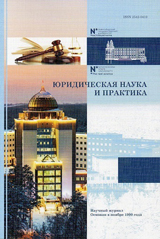
The journal "Juridical science and practice" was set up in order to create an opportunity to discuss current problems of theory and practice in the field of law, to disseminate the main scientific results obtained in the framework of dissertation research, to establish and strengthen scientific ties between scientists in Russia and other countries.
Mission of the journal-the journal publishes scientific articles and critical materials on jurisprudence. The journal expresses the general attitude and position of Novosibirsk State University, which combines intellectual freedom and demands for reasonableness of judgments, the desire for clarity and clarity of thinking, rationality of argumentation. The journal publishes materials corresponding to the main categories: history and theory of state and law; constitutional and municipal law; civil and business law; labor law and social security law; environmental law; civil and arbitration proceedings; administrative and financial law; criminal law and procedure, criminalistics; international law; scientific life, publications, reviews, translations.
Current issue
THEORETICAL-HISTORICAL SCIENCES
At present, global regulation has entered a new period of rapid change, and China is in dire need of a large number of international lawyers to protect its interests. Traditional legal education has obvious shortcomings, including outdated teaching concepts, teaching methods and many other problems. especially under the current relative scarcity of legal practice. if digital tools are not used in a timely manner to optimize teaching content and methods, it will inevitably have a negative impact on the education and training of international lawyers in China. In this context, it is particularly important to innovate digital-based education for international lawyers. Artificial intelligence and other digital technologies have opened up new opportunities for the education of Chinese international lawyers. The quality of training is enhanced through interdisciplinary integration, market-oriented practice and concrete measures: the establishment of a digital course system, the introduction of digital learning formats and the in-depth development of digital education platforms. This digital transformation in the education of international lawyers will contribute to the development of this fi eld and provide valuable guidelines for the formation of public policy in relevant departments.
The article discusses the issues of involving educational organizations in legal advocacy among young people. The author analyzes the provisions of the normative legal acts of the Russian Federation, examines the concept of “legal propaganda”, its relationship with the concept of “propaganda of legal knowledge”, as well as the points of view of scientists in this fi eld, which led to a number of conclusions. Using the example of educational organizations, the features of legal propaganda among young people are listed. The study of normative and empirical material has revealed the need to improve the legal regulation of the provision of qualified legal assistance to socially vulnerable categories of the population (Federal Law “On State Social Assistance”), as well as practical recommendations for the implementation of legal advocacy among young people with the involvement of educational organizations.
PUBLIC LAW SCIENCES
The article identifies the scientific, methodological, ethical and legal foundations of bioethical constitutionalism, reveals doctrinal approaches to understanding bioethics in the framework of international discussion, analyzes the features of the subject and methodology of bioethics, considers the importance of legalization and medicalization of the principles of bioethics and the formation of biojurisprudence and bioethical constitutionalism. In the modern period, under the influence of advances in the study of science and technology, there is a co-evolutionary development of bioethics, prescriptive constitutionalism and new human rights, which reflect the process of interweaving and active interaction of the biological, social, legal and cultural order.
The concept of bioethical constitutionalism is developing at the intersection of four areas of knowledge and achievements: biomedical ethics, biology, medicine and human rights. It is based on humanitarian biosecurity and the existential value of human life as a socio-biological and ethical-ideological phenomenon. The author comes to the conclusion that bioethical constitutionalism combines doctrinal, normative, institutional, medical-legal, technological and ethical-philosophical components. The article states that new human rights should include bioethical human rights in the field of somatics and reproduction (somatic and reproductive), which, together with bioneurotechnologies, determine, on the one hand, the biosafety of an individual and human society, and, on the other hand, facilitate the implementation of biosocial human reproduction and the maintenance of the boundaries of invasion into nature and human capabilities. The central place in the system of bioethical human rights is occupied by the right to biosocial reproduction, which has a complex nature and is an existential, biological and social expression of human capabilities and abilities to ensure the maintenance of anthropological diversity and intergenerational development of the human species on earth.
The article examines the nature of human dignity at the present stage. Particular attention is paid to judicial practice, considering human dignity as a principle, value, subsidiary source of other legal relations, an independent right, a source of other rights and freedoms, a condition for the exercise of other rights. The emphasis is on the unique property of human dignity as an ethical and legal phenomenon with independent legal significance. The problems of postmortem reproduction, the admissibility of moral experiences of an unborn child and the payment of appropriate social support measures are discussed. On the pages of the work, the author raises the issue of the need to fill the dignity of the individual (using the example of legal relations in the fi eld of human reproduction) with bioethical content through the interpretation by constitutional judicial bodies of new facets of emerging legal relations in the fi eld of bio- and neurotechnologies.
The article examines the process of constitutionalization of presidentialism in Russia following the 2020 constitutional reform, which resulted in the consolidation of the dominant role of the president in the system of state power. Key changes in the redistribution of powers among the executive, legislative, and judicial branches are analyzed, which led to the actual transformation of a mixed republic into a model with pronounced dominance of presidential authority. The article substantiates the concept of «institutional presidential centralization», where formal parliamentarization is combined with the actual strengthening of the president’s position in the system of power.
PRIVATE LAW (CIVILISTIC) SCIENCES
The study is devoted to the analysis of the formation of environmental awareness of subjects of environmental legal relations within the framework of state and regional environmental protection programs in the Russian Federation. Based on the analysis of the environmental situation, it was found that the actions of participants in environmental legal relations not only hinder the achievement of Russia’s strategic goals, but also pose a threat to well-being and quality of life. The implementation of the national project «Ecology» in the period from 2019 to 2024 made a significant contribution to improving the environmental situation. However, despite the achieved indicators, work in this direction should be continued to achieve even more significant results.
The article examines the concept of investment in Russian law from the perspective of investment law theory, existing investment legislation, and law enforcement practice. A comparative analysis of regulatory acts containing various definitions of investment has been conducted, identifying their shortcomings and contradictions. The necessity of unifying the legislative approach to defining investment is substantiated to eliminate legal conflicts and improve the effectiveness of law enforcement. It is concluded that investments should include only objects of civil rights that have a monetary valuation and are subject to investment in entrepreneurial and other activities to generate profit or achieve another beneficial effect.
In this article, the author notes the completed importation of the concept of “representations and warranties” from English law into Russian law. A number of arguments are presented demonstrating the discrepancy between the objectives of the institution of representations and warranties in English law and the objectives underlying Article 431.2 of the Russian Civil Code. The author draws attention to the absence of requirements for the form of expression of representations in Article 431.2 of the Russian Civil Code. Particular attention in the article is paid to the provision of representations regarding facts of the past, present and future.
The author puts forward proposals for adjusting the provisions of Article 431.2 of the Russian Civil Code, which can be taken into account by the Russian legislator when revising the provisions of the articles of the Russian Civil Code.
CRIMINAL LAW SCIENCES
Based on law enforcement practice, statistical data, and sources contained in the mass media, the article analyzes the features of the criminological characteristics of the personality of a criminal who commits crimes using artificial intelligence. The portrait of the criminal’s personality is considered through the prism of socio-demographic, criminal-legal, moral-psychological properties and personality traits in the context of the new information reality. It is stated that in most cases these are men between the ages of 25 and 29, Russian citizens with secondary education, who are not in an official marital relationship, who do not have dependent minors, and who commit several crimes against property. The perpetrators commit the crimes in question neither in a state of alcohol, nor in a state of narcotic or other intoxication. The motives vary, among the studied criminal cases, the selfish motive (77.6 %), gaming (14.5 %), hooligan (6.0 %), political (1.0 %), and others (for example, revenge, enmity) (0.9 %) prevail.
The article is dedicated to the problems of improvement of forensic support of investigation of criminal cases related to ecological sphere. The author designates some problem questions concerning the involvement of high-tech development into investigation of criminal cases of the above-mentioned category. Author’s personal experience of hearing cases related to environmental crimes allowed to express an opinion that the use of drones during verification of evidence on the crime scene which is aimed on solving tactical tasks of crime investigation is of vital importance. It serves rather an effective mean for setting procedural goals of investigation. Also the article includes the author’s suggestions for implementation of such high-tech method as remote verification of evidence on the crime scene during investigation ecological criminal cases.
The article states that the implementation of platform solutions is one of the elements of the digital transformation of crime detection, investigation and prevention. The author consistently analyzes the main problematic issues of the new stage of development of digital platforms from the perspective of their possible evolution: unambiguous identification and authentication of users; determination of the level and volume of access; solving the problem with the architecture of this system; solving the problem with the absence of duplication of electronic document management in paper form and signing documents in electronic form.; solving the issue of integrating the existing information arrays of individual law enforcement agencies while eliminating duplication of information; solving the issue of ensuring the security of electronic document management; introducing intelligent systems.
SCIENTIFIC LIFE
At the meeting of the Dissertation Council 24.2. 426.04 of the Russian Presidential Academy of National Economy and Public Administration on April 16, 2025, Serdyuk Alexander Alexandrovich successfully defended his thesis for the degree of Candidate of Law on the topic “Methods of investigating corporate embezzlement in the insurance sector” in the specialty 5.1.4 – Criminal law sciences (legal sciences). The Dissertation Council stated that the thesis of A. A. Serdyuk is a scientific qualification work that meets the requirements of the Regulations on the Award of Academic Degrees, approved by Decree of the Government of the Russian Federation dated September 24, 2013 No. 842 and the Procedure for awarding the degree of Candidate of Sciences, the degree of Doctor of Sciences at the Russian Academy of National Economy and Public Administration under the President of the Russian Federation, approved by the order of the Rector of the Russian Presidential Academy of National Economy and Public Administration (as amended by Order No. 02-0355 dated February 28, 2024). The study is characterized by scientific novelty, it contains a solution to a problem that is important for the development of criminal law science and law enforcement. Based on this, the dissertation Council decided to award A.A. Serdyuk the degree of Candidate of Law in the specialty 5.1.4 – Criminal law sciences (legal sciences). The article presents the main provisions of the review of a member of the dissertation council for a dissertation, in which the main provisions of the dissertation under consideration are analyzed.